
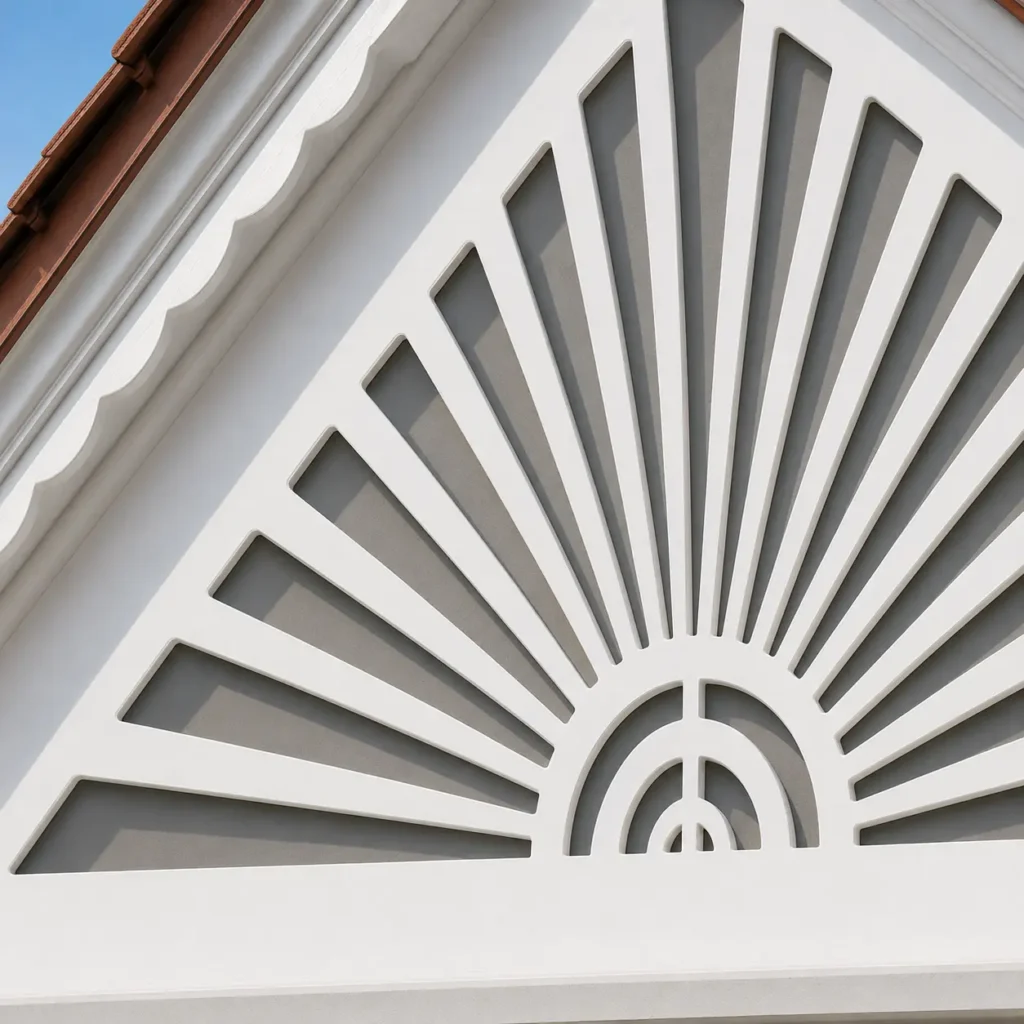
If you are choosing a jali for a gable, façade, balcony or boundary wall, you will be quoted at least three materials — PVC, WPC and multiwood — often by the same fabricator, at three different prices, with no explanation beyond “this one is better.”
Here is the short answer: for exterior decorative jali, PVC foam board is the right material, and it is not close. It cannot rot, cannot absorb monsoon water, cannot be eaten by termites, is light enough to fix overhead safely, holds fine CNC detail better than anything except metal, and costs the least of the genuinely durable options. Every other material on the list is either worse at this specific job or dramatically more expensive for no gain.
The rest of this article explains why, including the two things PVC does not do — because you should hear those from us rather than discover them after installation.
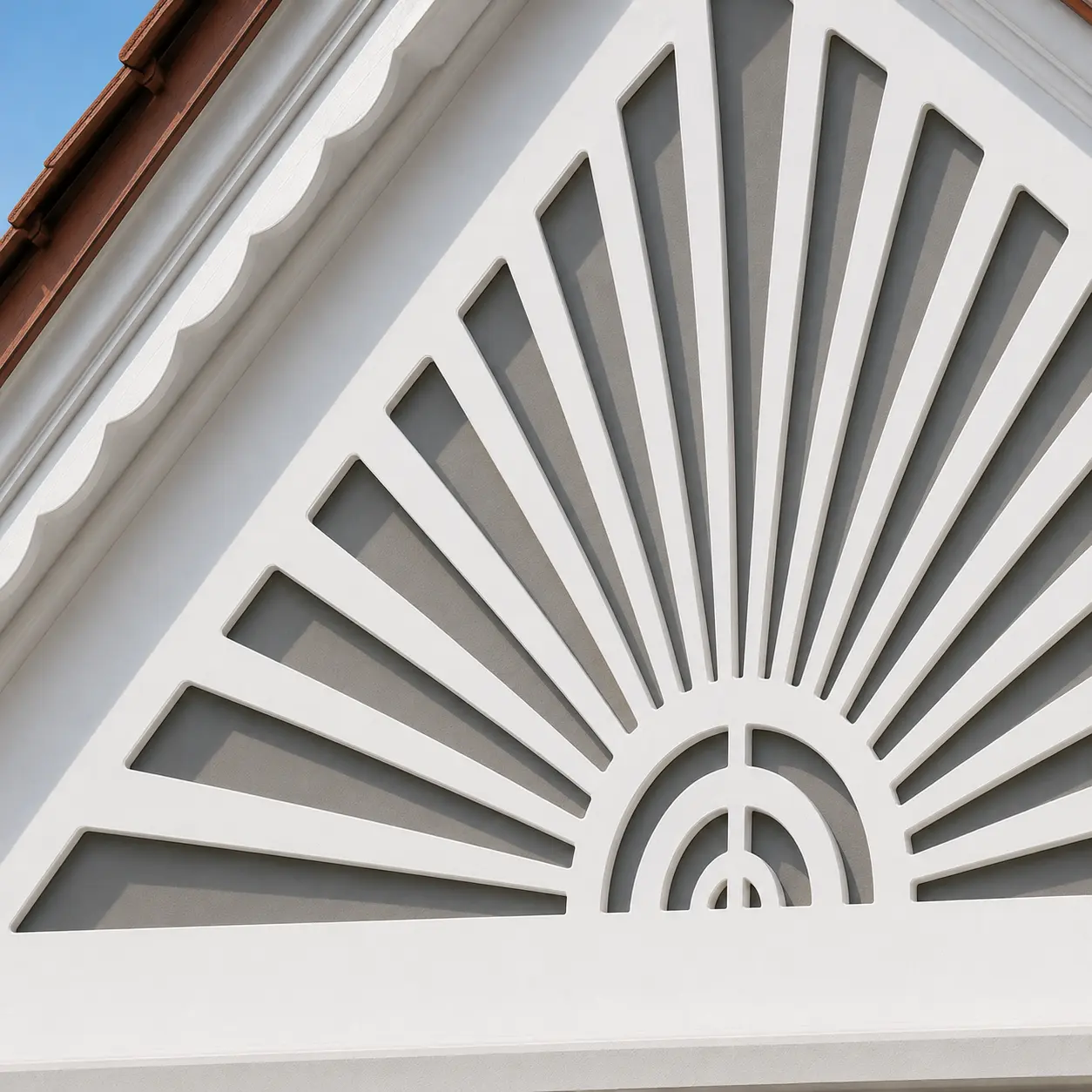
What actually destroys exterior jali in India?
Four things do almost all the damage. Every material comparison below is really a comparison of how each one handles these.
Ultraviolet light
Direct sun degrades most polymers over years — surfaces chalk, colours fade, unstabilised material turns brittle. This is the single biggest factor on any south- or west-facing elevation.
Water and humidity
Monsoon rain does not just wet a panel. It drives water into cut edges, screw holes and joints. Any material containing wood will take up that water and swell. Coastal humidity does the same thing slowly, all year round.
Termites and fungal decay
In most of India, anything with organic content fixed to an exterior wall is food. This rules out untreated wood, MDF and plywood outdoors regardless of what finish is applied over them.
Thermal movement
Panels expand and contract as surface temperature swings between a monsoon morning and an April afternoon. Every plastic-family board does this. It is not a defect — it is physics, and it is handled at installation by allowing movement at the fixing points rather than screwing a long panel rigidly at both ends.
What is PVC foam board?
PVC foam board is a rigid, closed-cell expanded PVC sheet, sold in the trade as foam PVC, sunboard or celuka board depending on the manufacturing process and density.
Why it wins outdoors: it contains no wood and no organic filler, so there is nothing to rot and nothing for termites to eat. The cells are closed, so it does not absorb water — a cut edge left exposed to driving rain behaves exactly like a sealed one. This matters enormously for jali specifically, because a jali is almost entirely cut edge. It is light, which is decisive when you are fixing a large panel overhead into a gable wall. And it routs cleanly on a CNC, holding intricate pattern detail without chipping.
The two things it does not do. First, it is not structural — it is a decorative skin, fixed to a wall or a light frame, never spanned across an opening like a beam. Second, it softens at sustained high temperature, so it is a poor choice hard against hot metal or directly above a heat source.
Neither limitation applies to a decorative gable panel fixed to a wall, which is why PVC foam board is the correct answer for that job and a poor answer for a door frame.
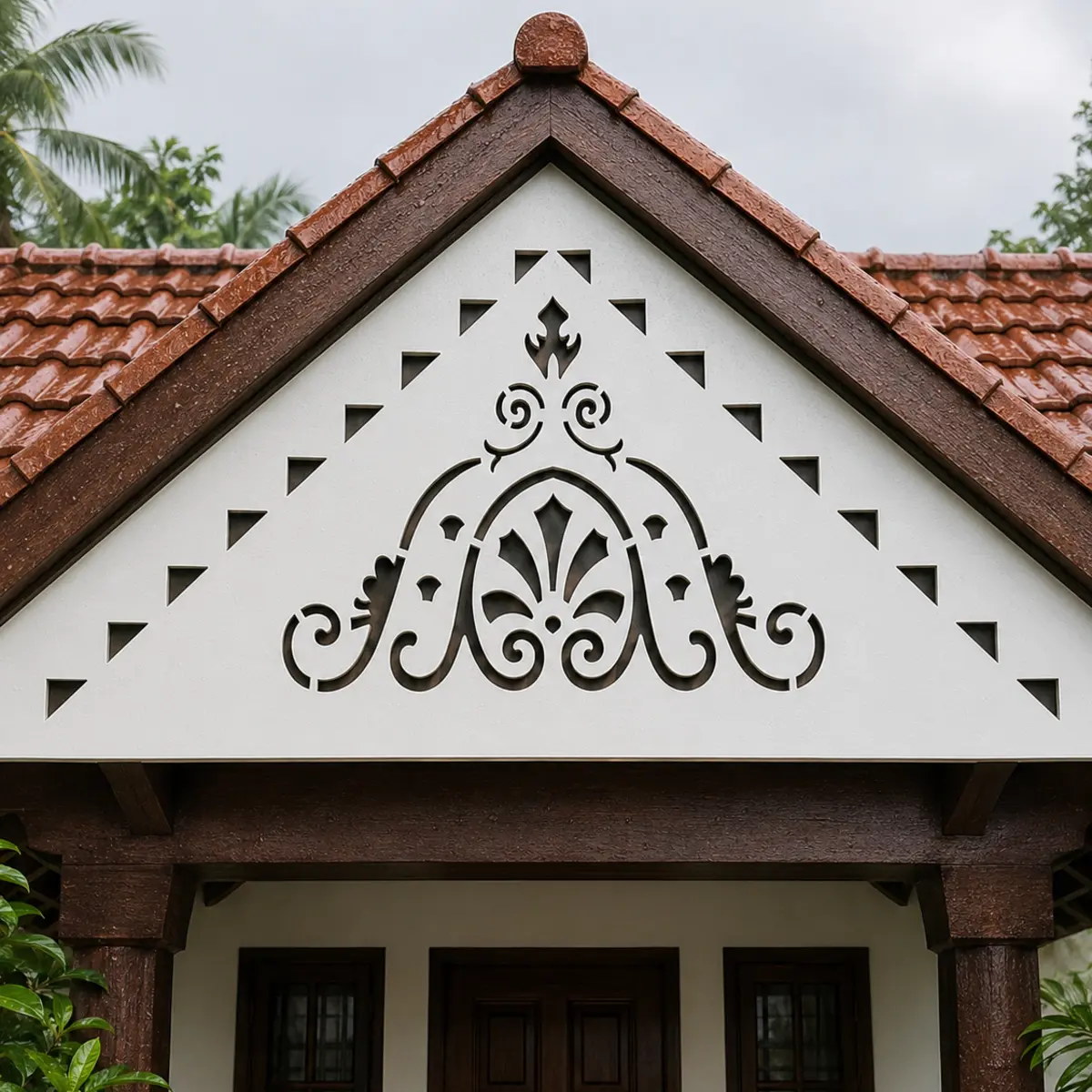
What is WPC, and why is it not ideal for jali?
WPC is wood plastic composite — wood flour or rice husk mixed with a polymer binder. The wood-to-polymer ratio varies enormously between manufacturers, and that ratio is the whole story.
WPC is denser and more rigid than PVC foam board of the same thickness, holds screws better, and is the sensible choice for anything semi-structural: door frames, louvers, decking, framing.
But it has wood in it. A high-polymer WPC handles rain well. A cheap, high-wood-content WPC does not — and the exposed cut edges of an intricate jali pattern are exactly where the wood fraction meets the weather. Over repeated wet-dry cycling you can get edge swelling, surface roughening and discolouration. It is also considerably heavier, which matters when the panel is going overhead.
WPC is a good material used for the right thing. A jali, with its enormous ratio of cut edge to surface area, is the application that plays least to its strengths.
Is multiwood different from PVC?
Usually not. In the Indian market, “multiwood” is generally a PVC-based board despite the name — it typically contains no wood at all. It is a denser PVC sheet marketed as a plywood substitute for furniture and interiors. Brand names vary, densities vary, and specification is inconsistent between suppliers.
What this means for you:
- If you are quoted “PVC” and “multiwood” as fundamentally different materials, they are usually the same family at different densities.
- Multiwood’s higher density gives better screw-holding and a more solid feel, which is why it suits shutters and interior furniture.
- For a routed decorative jali, that density buys weight and cost without buying durability — PVC foam board was never going to rot in the first place.
Ask any supplier quoting multiwood for the density and thickness rather than the brand name. If they cannot tell you, that is your answer.
What about wood, MDF and metal?
MDF, HDHMR and plywood — indoor only. Marine ply and HDHMR are more water-resistant than standard MDF, not waterproof, and none belong on an exterior gable in a monsoon climate. The finish will fail before the board does, and then the board will fail.
Natural wood (teak, sal) — genuinely durable in the right species, properly treated, and expensive. It needs re-oiling or re-coating for its entire life. If you want wood and will maintain it, it is a legitimate choice. If you want a jali you can forget about, it is not.
Metal (MS, aluminium, stainless CNC) — the most durable option and by far the most expensive. Mild steel needs a proper coating system and rusts at any scratch, which is a serious problem within a few kilometres of the coast. Aluminium and stainless do not rust, and cost accordingly. Metal is heavy enough to need structural fixing rather than surface fixing. It is a real option if budget is not the constraint; for most houses it is three to five times the cost of PVC for a panel nobody touches.
Comparison table
| PVC foam board | WPC | Multiwood | MDF / ply | Metal | |
|---|---|---|---|---|---|
| Contains wood | No | Yes | Usually no (PVC-based) | Yes | No |
| Termite-proof | Yes | Depends on wood content | Yes | No | Yes |
| Water absorption | Negligible | Low to moderate, edge-dependent | Negligible | High | None |
| Weight | Light | Heavy | Medium–heavy | Medium | Heavy |
| Holds fine CNC detail | Excellent | Good | Good | Good | Excellent |
| Structural capability | None — decorative | Semi-structural | Semi-structural | None outdoors | Structural |
| Rusts near the coast | No | No | No | No | Mild steel: yes |
| Maintenance needed | None | Occasional | None | Constant | Coating upkeep on MS |
| Suits exterior gable jali | Yes — best choice | Workable, not ideal | Yes, at more weight and cost | No | Yes, at 3–5× the cost |
| Relative cost | Low | Medium | Medium | Low | High |
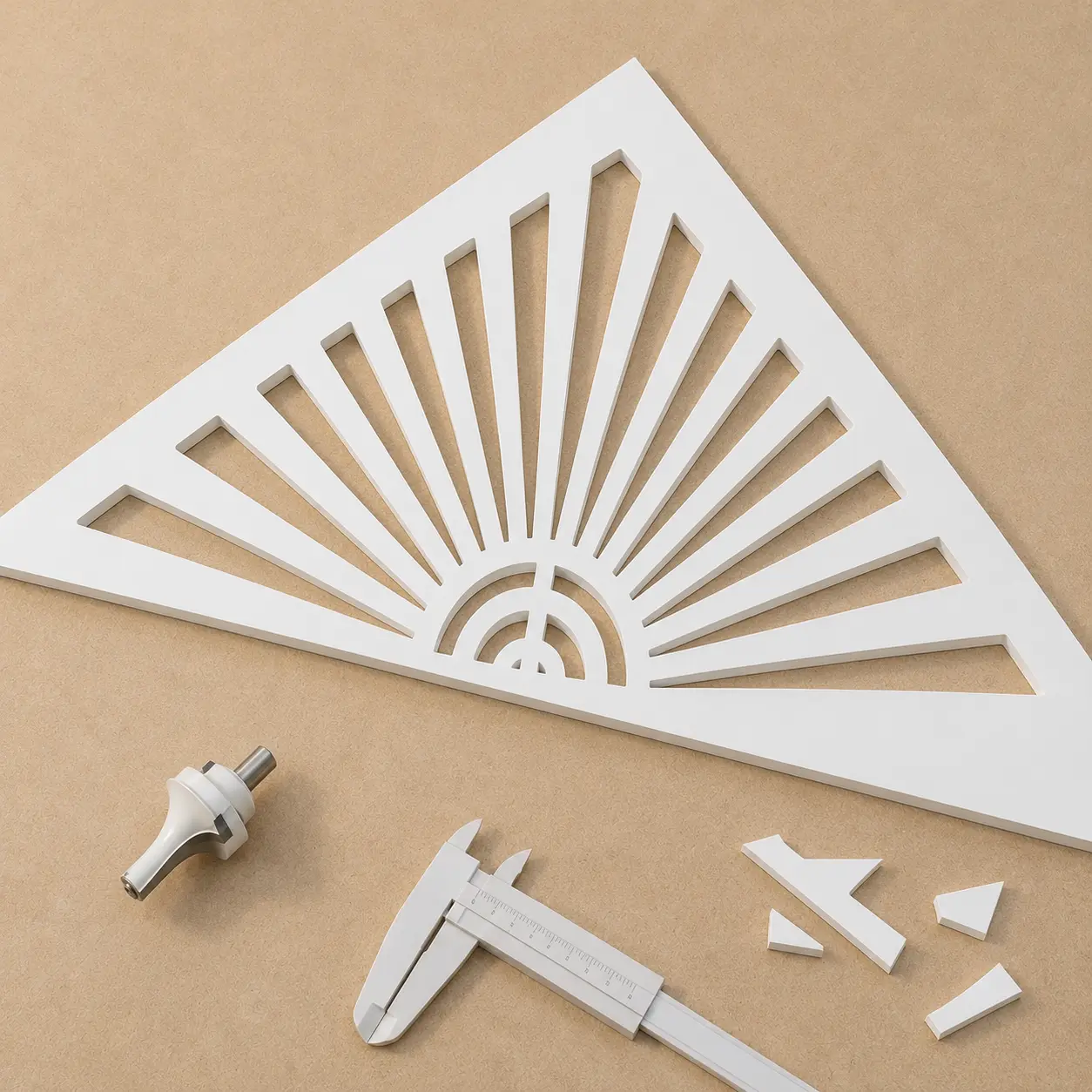
Which thickness should you choose?
Material choice matters less than most buyers assume once you have ruled out wood. Thickness matters more.
- 8 mm — the standard for most gable and façade work. Adequate for a normal panel with sensible fixing points, and the most economical.
- 10 mm — a step up in rigidity. Worth it on larger single panels and more exposed elevations.
- 12 mm — for large spans, deeper shadow lines, and anything taking driving rain and full afternoon sun.
- 18 mm — where the pattern relief itself is the design feature and you want a genuinely three-dimensional shadow.
A thicker board gives a deeper cut face, which reads as more substantial from the ground. On a gable seen from twenty feet below, that shadow depth is most of the visual effect.
So which should you choose?
Gable, façade or elevation panel: PVC foam board. 8 mm as standard, 10 or 12 mm if the elevation is large or fully exposed.
Shaded balcony or interior partition: PVC foam board again, and you can go thinner. Almost anything survives here, so choose on appearance and price.
Anything semi-structural — louvers, frames, spanning an opening: not a jali panel at all. Use WPC or metal, specified properly.
Within a few kilometres of the sea: avoid mild steel entirely. Salt air is unforgiving of coatings, and a rusting jali is worse than no jali.
What we cut, and why
Bright N Wall® and SS ARTS cut exterior jali from PVC foam board in 8, 10, 12 and 18 mm on a CNC router. We chose it for gables and façades for the reasons above, and we have not found a reason to change.
We cut to your measurements rather than selling fixed panel sizes, because a gable triangle is never a standard size and joining panels to fill one looks like joined panels.
Send a photograph of where the jali is going with rough dimensions and we will tell you which thickness suits that exposure — including when 8 mm is enough and you do not need to spend more.
Browse PVC gable jaali designs →
Read the measurement guide →
Send your size for a quote →
Not seeing the pattern you want? We have 500+ designs in our full catalogue. Ask for it on WhatsApp →
Frequently asked questions
Is PVC jali strong enough for a gable?
Yes, for a decorative panel fixed to a wall or frame. It is not a structural element and should not span an opening unsupported. Match thickness to panel size and exposure — 8 mm for standard work, 12 mm or more for large, fully exposed elevations.
How long does PVC jali last outdoors in India?
It does not rot, does not absorb water and cannot be eaten by termites, so the failure modes that end a wooden or MDF jali simply do not apply. Over many years of direct sun any polymer surface will chalk and lose some finish; a shaded or partly shaded elevation will look new considerably longer than a west-facing one.
Is multiwood better than PVC for outdoor jali?
No. They are usually the same family of material at different densities, and multiwood is heavier and more expensive without being meaningfully more durable in this application. Ask the supplier for density and thickness rather than the brand name.
Is WPC better than PVC for jali?
Not for jali specifically. WPC is denser and better for semi-structural work like frames and louvers, but it contains wood, and a jali is almost entirely exposed cut edge — which is where wood content is most vulnerable to monsoon wet-dry cycling. It is also heavier to fix overhead.
Does PVC jali expand in heat?
Yes — all plastic-family boards do. It is handled at installation by allowing movement at the fixing points rather than screwing a long panel rigidly at both ends. Ask whoever installs it how they are allowing for expansion; the answer tells you a lot about them.
Can PVC jali be painted?
Yes, with a primer suited to PVC. Most customers keep the standard white, which reads cleanly against a coloured wall and needs no maintenance.
What does PVC gable jaali cost?
Pricing is per square foot: ₹220 for 8 mm, ₹240 for 10 mm, ₹300 for 12 mm and ₹340 for 18 mm, with a 16 sq ft minimum and shipping charged separately. A 12 ft × 6 ft gable is 36 sq ft, so ₹7,920 in 8 mm.
 House Name Plates
 Office Sign Boards
 PVC Jaali Design
 PVC Roof Borders
 PVC Gable Jaali
 Corporate Gifts
 Wall Art
 Wall Clocks
 Number Plates
 Diwali Decorations
 Shelves & Storage